
Ingenue
ingenue(n.) "young woman who displays innocent candor or simplicity," 1848, from French ingénue "artless girl," especially as a character on the stage,

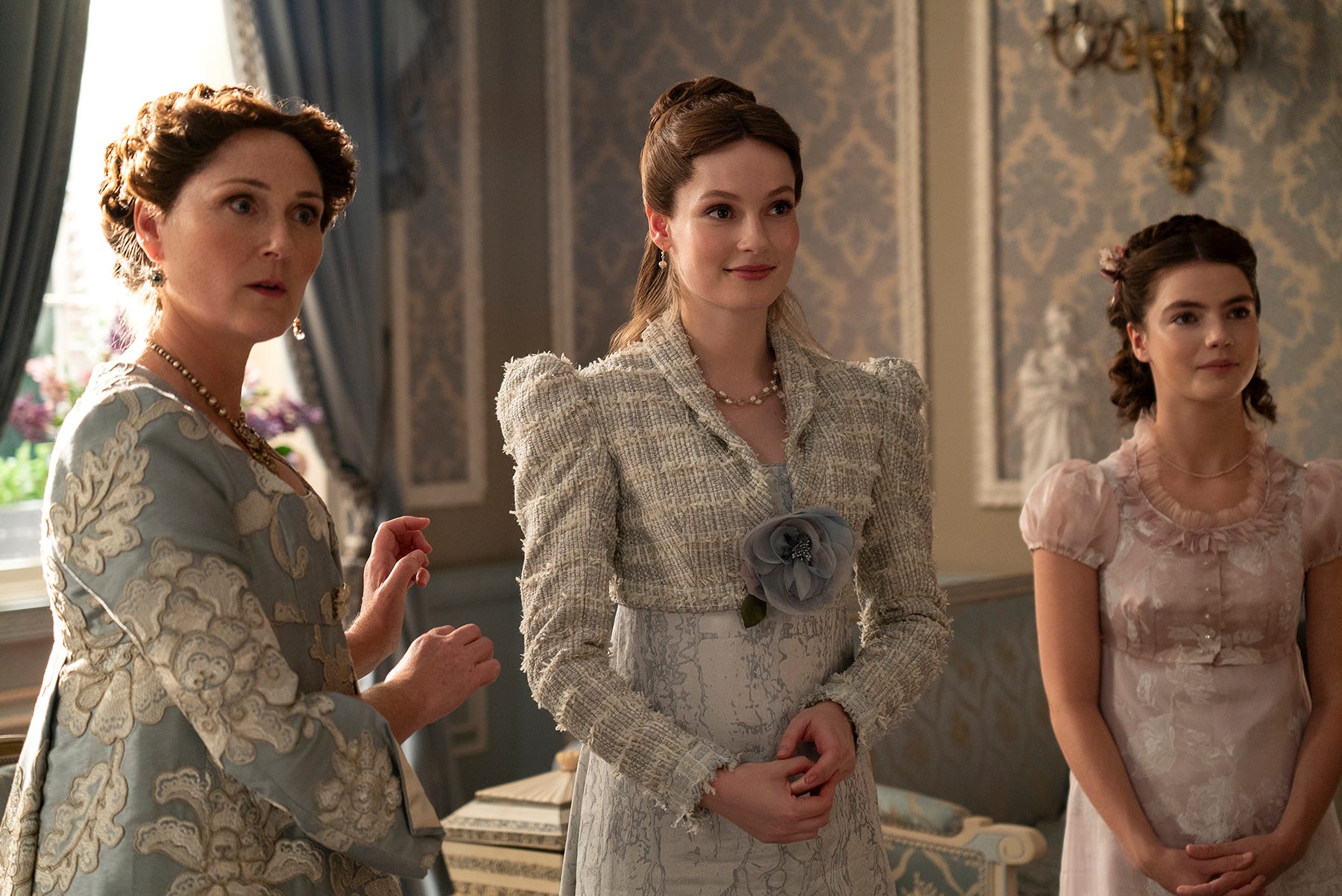
It is an occupational hazard, I suppose, that I cringe when Bridgerton refers to debutantes as ingenues. As a Regency author , I sit down for a bit of escapism, only to find myself physically recoiling at a single word. My recent “cringe” moment arrived courtesy of Bridgerton, where the term ingénue was tossed about to describe the season’s debutantes.
The Etymological Dictionary marks this usage as appearing in 1848. To use it in 1813 is a linguistic leap of thirty-five years. While one might have substituted debutante—recorded by 1817 and far more forgivable—the choice was a word that simply does not belong in the mouth of a Regency gentleman or lady.
Language is the first casualty in modern adaptations. This season, the show employed “pinnacle” as a euphemism for a woman’s climax. I would be hard-pressed to find a contemporary source for such a term. Even the bawdy 1811 Dictionary of the Vulgar Tongue by Francis Grose lacks specific references to that sensation, though it offers colorful terms for the act itself:
Blanket Hornpipe: The act of intimacy.
Melting Moments: A fat man and woman in the embrace.
To me, “pinnacle” feels like a modern bridge to “climax” (not recorded in a sexual sense until 1880), a clever attempt to translate 21st-century sensibilities into empire-waisted gowns.
Accuracy vs. Pedantry?
Beyond the vocabulary, I find the inaccuracies in costuming, the lack of chaperonage, and the casual approach to introductions make the show a beautiful, albeit messy, fantasy. This leaves me at a blurry crossroads: where do we draw the line?
I strive for period-appropriate vocabulary—the operative word there is "strive." I believe modern psychology—”processing feelings” or seeking “closure”—has no place in 1812. Yet I respect the hierarchy of the “back stairs” and the etiquette of calling cards because these details create the atmospheric tension my readers crave.
Do readers want a historical documentary or an enjoyable story? Most want the latter, but when the language is lost, the “flavor” of the era can vanish—the elegance, the wit, and the subtle power of what is left unsaid.
Running across “laid back” or kilometers in a story can be most jarring. Arguing about the exact origin of this sleeve or that can be just so much posturing.
My compromise: I shall continue to use “cannot” instead of “can’t” and ensure my gentlemen ask permission before they call. I do this not for the sake of pedantry, but because I believe the beauty of the Regency lies in its rules—and the delicious ways they are navigated and broken.
.
Thank you for the "Regency" commentary. I have become less enamored of "period" shows that seem a vehicle for modifying history to meet current social trends in language, fashion, and especially propriety/ morality.
I'm not so naive as to think there was no premarital messing around, but there were propriety rules that are selectively applied in the name of entertainment.
I agree wholeheartedly. I am a volunteer proofreader for a few JAFF authors (mostly here on Substack) and improper use of spelling, grammar and punctuation are my pet peeves. I also strive to point out errors which do not belong to the Regency period in which JA wrote. Presentism is also evident in some authors’ work, though I note that it is more prevalent in movies and TV than in publishing. That is one of many reasons I gave up watching TV - the most prevalent reason being that Hollywood has lost its creativity in all forms except social criticism.